Costa Concordia Disaster Recovery

You’re just finishing off your evening meal, swirling the remains of wine in your glass and reflecting on today.

“It was a good meeting, we got a lot done; this will be a good year” and then the phone rings…

I don’t know if that’s exactly how it happened to Micky Arison, Chairman and Chief Executive of Carnival, but I’m sure the news was greeted with the same feeling in his stomach that we all would have felt.

Heaven forbid anything so disastrous should happen to your business, but what if?

What would your first actions be?

We talk about strategy, financial management and the nuances of the sales and marketing plan but have we covered off disaster or mitigation thereof?

It doesn’t have to be of the magnitude of the Costa Concordia, perhaps a trade debtor gone into receivership. Last year Focus DIY’s demise caused some huge financial losses across the transport sector not to mention actual product suppliers; how many businesses can withstand those losses?

An employee injuring himself at work could potentially expose the Directors to a jail sentence due to an overlooked health and safety issue that was dormant for years; the list of threats goes on.

I’m not a harbinger of doom and my heart and prayers goes out to those whose lives were lost but we must take heed and learn. We as Directors have a duty of care not just to our employees but also our shareholders (read balance sheet)

Our businesses may have become more sophisticated, technology dependent but our plans don’t have to be. In 1957 Jaguar Cars Ltd suffered a huge fire at their Brown Lanes factory, a fortnight later and the first Jaguar Mk1 rolled back off the production line – not a computer backup in sight, nor even thought about.

I repeat the question – what would your first actions be and where is your disaster plan?
Posted in Organisation, Strategy, Systems | Tagged , , , , , | Leave a comment

Pause For Thought

This Blog is written with a clear intent in mind. It is written to cajole, nudge, prompt and make you, the Director and Senior Manager, stop and think about what is happening within your organisation.

If you survived last year you did well or perhaps as a colleague described it you were “a zombie company” existing to get from one day to the next without challenging the status quo and doing credit to the many skills and experience that got you to where you are today.

I don’t want to patronise, but last year, I saw time and time, again figures and information being presented that oscillated between doom and gloom and high aspiration, each trying to make sense of the dynamics of the economic position and I wonder did you question and give thought to the next three years and if so where did those thoughts feature in your business plan?

I also wrote last year that the business models that we have grown with are being firmly overturned and that if you don’t stop and at least consider the fundamental added value drivers of your business then change will be forced upon you, perhaps for the worse.

By way of levity I’m giving you this excellent video from a software house called Kimble. There are some very good, thought-provoking statements being made.

I hope you enjoy and as ever, if you’d like to discuss any of the topics raised then please don’t hesitate to pick up the phone.

Posted in Strategy | Tagged , , | Leave a comment

Wishing You A Prosperous & Happy 2012

“Once more onto the breach dear friends”

Wishing you a peaceful, prosperous and happy new year.

Mike

Posted in Uncategorized | Tagged | Leave a comment

E-Mail Ban at Atos

In case you missed the item, last week, Thierry Breton, the CEO of ATOS, an international company of some 70,000 employees, announced that he was to ban e-mails throughout the organisation within the next eighteen months.

Ignoring the speculative hype regarding the form that this might take and concentrating on the intent, you have to take a step back and think about the implications.

I sat at the weekend watching my two young sons who were smiling and laughing to themselves whilst on Facebook; the mobile beeped and one of them responded with what I presume was a txt. This scenario played itself out for an hour whilst at the back of my mind I was thinking about the e-mail ban at ATOS.

Eventually I asked “why do you not just pick up the phone to speak to them?” to which came the response “but I am Dad!”

So what do you think?

Over to you…

Posted in Organisation, Systems | Tagged , , | Leave a comment

Autumn Statement 2011

George Osborne presented a not unsurprising statement given the debt laden economy, but within the statement there were some opportunities to be looked at and considered.

The following key points are taken from business zone, posted by John Stokdyk.

Kicking off the speech with a review of revised Office of Budget Responsibility forecasts that showed growth dropping to below 1% in 2011 (0.9%) and 2012 (0.7%), the chancellor looked towards a recovery to 2.7-3% in 2014-16 that would allow the government to achieve its long-term goal of balancing the budget by the end of this Parliament.

•A £21bn credit easing initiative based around a National Loan Guarantee Scheme to lower the cost of bank loans for businesses with turnovers up to £50m. Participating banks will be able to raise up to £20bn over the next two years under the guarantee scheme, provided they pass through this lower cost of funding to smaller businesses in lower interest rates on new loans and overdraft – subject to State Aid approval from Europe, small firms should be able to apply for these funds through participating banks in the normal way.

•A £1bn Business Finance Partnership scheme to raise non-bank finance for small and medium-sized Businesses. The government will begin the process of allocating funds early in 2012.

•Enterprise Finance Guarantee (EFG) will be extended from January 2012 to include businesses with up to £44m annual turnover.

•New Seed Enterprise Investment Scheme (SEIS) to be launched in April 2012, offering 50% income tax relief on investments, along with a Capital Gains Tax exemption on gains realised in 2012-13 and then invested through SEIS in the same year. In addition, the government will simplify and refocus the Enterprise Investment Scheme and Venture Capital Trusts.

•Small business rate relief holiday extended for a further six months from 1 October 2012. The Government will also give businesses the opportunity to defer 60 per cent of the increase in their 2012-13 business rate bills as a result of the RPI updating, to be repaid equally across the following two years.

•Extend the R&D tax credit scheme to larger companies in 2013, subject to detailed consultation at Budget time next year. The existing SME R&D incentives will not be affected.

•An extra £1bn for the Regional Growth Fund for England between now and 2014-15, along with a range of infrastructure projects that will be devoted to improving transport and broadband internet services in the regions.

•Make 100% capital allowances available in the Black Country; Humber; Liverpool; North Eastern; Sheffield; and Tees Valley enterprise zones. Further extensions are planned to zones in the North East and a potential new zone around the Battersea power station in London.

•Bring forward employment law and health and safety reforms under consideration part of the Red Tape
Challenge.

•More than £5bn additional spending promised for investments set out in the National Infrastructure Plan, backed by £20bn from UK pension funds.

Are any of the above worthy of Agenda Topic at you next board meeting?

Posted in Finance, Strategy | Tagged , | Leave a comment

Quantas Twitter Faux Pas

Poor Quantas, can’t do right from wrong it seems. My posting earlier this month was serious when I asked the question “what else could the Company be faced with”? – I didn’t expect it to be a self-inflicted PR gaff from a social media campaign.

The foray into social media using Twitter has caught Quantas out before. Earlier in August it offered a prize of two rugby tickets. I won’t relay the story but the politically correct brigade failed to see any humour in the winning rugby fans dress sense and Quantas found itself in trouble.

This week Quantas asked an innocent question of their Twitter followers to”name their dream luxury in-flight experience”. Against a backdrop of industrial relations problems and service delivery issues the wit and sarcasm was quick to fly and not in a positive direction either.

How do you control the viral media of social networks? you can’t of course but perhaps you can learn from others how to manage it.

Posted in Organisation | Tagged , | Leave a comment

Stop Budgeting Start Improving

An interesting article has appeared in the Harvard Business Review regarding budgeting. The tenet of the article is that you should abandon budgeting as a management process and instead focus upon driving inefficiency out of the cost drivers to the business.

The citation for this notion is that Management spend far too much time collating, discussing and disseminating budgetary information across the organisation; the article gives examples of large organisations that have relinquished the budgetary process and adopted the aforementioned principle.

I’ve been pondering this notion around in my head for some time and can see where the author is coming from but I’m not entirely convinced that I would want to let go of my numbers as they are the ones that have established my KPI’s; it’s my KPI’s that I manage surely, not my budget?

I do believe however that there is a lot to commend this principle if the Management Team have the ability to understand the structural and operational cost drivers but at some point someone must establish what they are from a zero base and once having done that, then to move forward to managing them, but have we not just come full circle in our logic?

Perhaps what should actually be said is “establish the budgets once and then manage them by spending the time on driving the inefficiency out of the operational cost drivers”

I’d be interested in your thoughts – drop a line or call; always welcome.

Posted in Finance, Organisation, Strategy | Tagged , , , | Leave a comment

Quantas Airline and SWOT Analysis

I was reading this morning that a Quantas flight had an un-scheduled landing in Dubai due to an engine oil leak.

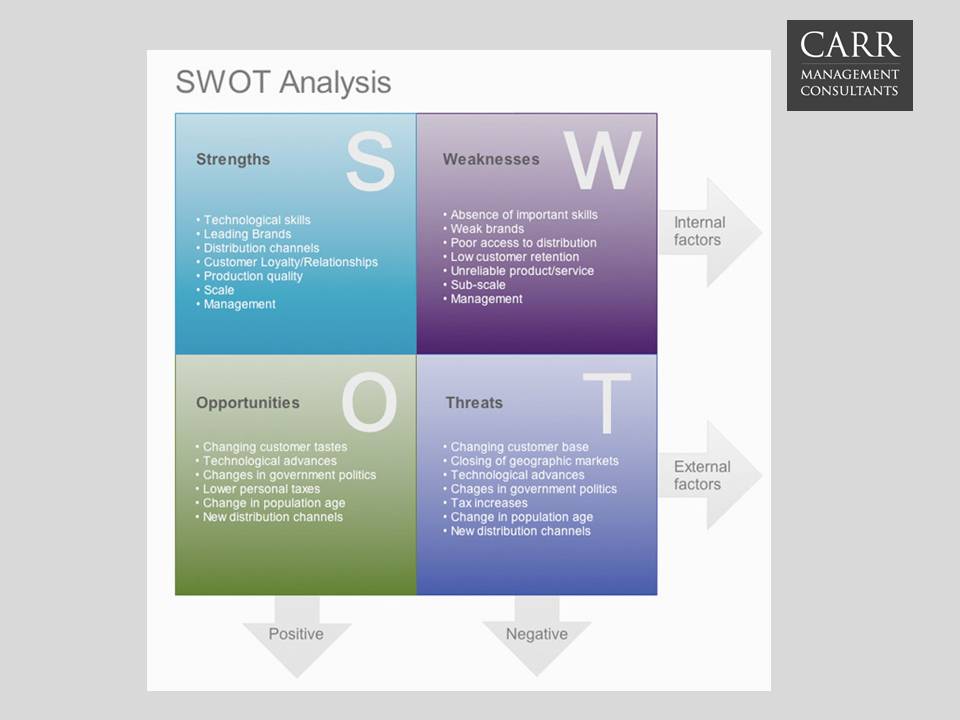
The news in itself doesn’t warrant the headlines, as anyone in the transport business would testify, but it did set me thinking of the unfortunate malaise that Quantas have suffered this past year and how the Directors were re-acting to it. I wondered whether the basic SWOT Analysis model featured in their business planning and if so, how they had mitigated or exploited the different elements.

Quantas have suffered internal union problems, engine design issues, rising fuel costs, consumer body compensation, floods, earthquakes and a tsunami; I think you could probably put a tick in every box.

I write this blog to cajole and nudge you because sometimes as a Director you’re just too busy “doing and reacting” when in fact you should be planning.

I’m not too sure that having a title “A Series of Unfortunate Events” on your CV is a good thing, unless of course you’re Lemony Snicket; for the rest of us we might just want to dust off our SWOT Model.

As always, drop a line or call to talk things through – we’re here to help.

Posted in Organisation, Strategy | Tagged , | Leave a comment

Good Judgement

“Good judgment comes from experience and experience comes from bad judgment” – Barry LePatner

Posted in Uncategorized | Tagged | Leave a comment

Responsibility for Accounts

One of my clients has had a particularly tough year and is only now being to see their way out of it. Thanks in no part to sheer hard work on behalf of all of the staff and our own involvement in sorting out their internal systems, financial controls and giving them a strategic focus to work to.

I’ve just received their accounts from a well respected firm of accountants and it set me thinking. The accounts have been prefaced by a missive detailing how they are members of the Institute of Chartered Accountants England and Wales (ICAEW) and how these accounts have been prepared within their guidance terms.

I’m very much in favour of Service Level Agreements and Terms Of Trading and I do understand the difference between audited and non-audit accounts but at what point does “we do not accept or assume responsibility to anyone other than you” or “We have not verified the completeness of the accounting records or information” further- “Current Assets is stock as valued by Proprietors”.  At what point does the firm of Accountants assume responsibility for anything that it has done, or is it just when they submit a Sage timesheet itemised in minutes and charged by the guinea?

This client was in major difficulty, their asset list was woefully out of date, their liabilities mis-stated and there was no meaningful management information and no KPI’s in place and yet the Accountants have charged over £7,000- for what? Washing their hands and saying “it wasn’t me!” Where were they when trouble reared it’s head? A mile down the road hiding behind an air of professional competence which is so ironic given that having a “Client focussed relationship” is their strap line.

Posted in Finance, Systems | Leave a comment